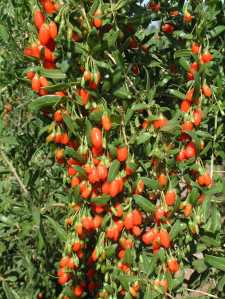

Wolfberry, scientifically known as Lycium barbarum, belongs to the Solanaceae family and grows as a deciduous shrub featuring gracefully arching branches that can extend up to 10 feet tall. This remarkable plant yields small, oval-shaped red fruits, which are carefully gathered for both culinary and therapeutic purposes. Originating from China, the majority of the global wolfberry production occurs there, particularly in regions such as the Ningxia Hui Autonomous Region and the Xinjiang Uygur Autonomous Region, as noted by Engels and Brinckmann in 2017. In the Chinese language, the plant is referred to as gouqi (枸杞), while its fruit is known as gouqizi (枸杞子). The term gou shares a linguistic connection with characters meaning “dog” or “wolf,” which explains the English common name wolfberry. Within the United States, these fruits are more popularly recognized as goji berries, derived from an Americanized version of the pronunciation of gouqi, according to sources like Dharmananda (2007) and Engels and Brinckmann (2017).

During the early 2000s, a product marketed as “Himalayan Goji Juice” gained significant traction in the United States, promoted heavily as a superfood. However, experts clarify that the label “Himalayan goji” serves purely marketing objectives and does not indicate any genuine geographical origin for the fruit, as highlighted by Engels and Brinckmann (2017). Historical records first mention Lycium in a collection of poems from the Zhou Dynasty, spanning roughly from the 1100s to 300s B.C.E., titled the Book of Songs. This ancient text vividly describes the process of harvesting the plant’s fruits. The earliest documented medicinal applications appear in the Shennong Bencao Jing, a foundational herbal text dating back to the 1st century C.E.
In the framework of Traditional Chinese Medicine, wolfberry plays a vital role in nourishing the kidneys and liver, moistening the lungs, enriching the blood, and enhancing visual acuity. Contemporary scientific studies corroborate the benefits of wolfberry for eye health, particularly in supporting vision. The fruits are rich in zeaxanthin and lutein, two potent carotenoids that the body readily absorbs into the retinal macula lutea. The robust antioxidant properties of these compounds offer protective effects against conditions like macular degeneration, as supported by research from Dharmananda (2007) and Engels and Brinckmann (2017). Beyond vision support, wolfberries find application in managing diabetes, alleviating dizziness, and serving as a promoter of longevity, according to Dharmananda (2007) and Yao, Heinrich, and Weckerle (2018).

The reputation of wolfberry as a longevity aid has inspired several captivating folk tales passed down through generations. One such story recounts a wandering scholar who stumbles upon a young girl or woman seemingly assaulting an elderly man. Outraged by what he perceives as disrespect toward an elder, the scholar intervenes. To his astonishment, the girl explains that the man is actually her great-great-grandson, and she is chastising him for neglecting to consume wolfberries, which would have preserved his youth. In another enchanting narrative, an entire town—or in variations, a community of monks—boasts residents who have reached the age of centenarians. The secret to their extended lifespans lies in a shared village well surrounded by thriving wolfberry plants. The fruits naturally fall into the water, infusing it with potent, life-prolonging nutrients that the villagers drink daily.
Beyond its medicinal heritage, wolfberries hold a prominent place in Chinese cuisine as a nourishing food item. They are frequently incorporated into rice congee, hearty soups, brewed into soothing teas, and even combined with grapes to produce flavorful wines, as detailed in various sources from 1997 to 2021 under the topic of wolfberry. Given the plant’s membership in the Solanaceae family—known for harboring toxic members—scientists have thoroughly examined its chemical makeup to address potential safety concerns. Could this shrub contain hazardous alkaloids such as atropine, hyoscyamine, or scopolamine, akin to its more dangerous relatives? An early investigation hinted at trace amounts of atropine in the fruits, but subsequent scrutiny revealed flaws in that study, suggesting the samples might have come from misidentified species other than L. barbarum (Qian, Zhao, Yang, and Huang, 2017).
Rigorous follow-up research, utilizing accurately identified cultivars of L. barbarum, definitively established the absence of any toxic alkaloids. This comprehensive analysis confirms that wolfberries pose no health risks and are entirely safe for regular consumption (Kokotkiewicz, Migas, Stefanowicz, Luczkiewicz, and Krauze-Baranowska, 2017). The enduring legacy of wolfberry in both traditional practices and modern wellness underscores its versatility, bridging ancient wisdom with contemporary nutritional science. From the lush shrubbery of Chinese landscapes to global markets as goji berries, this plant continues to captivate with its vibrant fruits and multifaceted benefits.
Exploring further into its cultivation, wolfberry thrives in arid and semi-arid environments, reflecting its native habitats in northern China. Farmers in Ningxia meticulously hand-pick the ripe berries during the harvest season, often under traditional ceremonial conditions, preserving cultural rituals that date back centuries. These practices not only ensure high-quality yields but also maintain the integrity of the plant’s therapeutic compounds. The shrub’s resilience allows it to withstand harsh winters, sprouting anew each spring with its characteristic arching stems adorned by delicate purple flowers that precede the fruiting phase.
Nutritionally, wolfberries stand out for their impressive profile, packing polysaccharides, vitamins, and minerals into each small berry. Studies highlight their role in boosting immune function, stabilizing blood sugar levels, and combating oxidative stress, making them a staple in health-conscious diets worldwide. In culinary applications, their slightly sweet-tangy flavor enhances both sweet and savory dishes, from trail mixes and smoothies to medicinal tonics and desserts. This adaptability has fueled their rise in popularity beyond Asia, integrating seamlessly into Western superfood trends while honoring their profound historical roots.
The interplay between folklore and science surrounding wolfberry exemplifies how cultural narratives can align with empirical evidence. Tales of eternal youth find echoes in research validating anti-aging antioxidants, while practical uses in daily meals affirm centuries-old safety records. As interest in plant-based remedies grows, wolfberry exemplifies a bridge between heritage and innovation, inviting enthusiasts to incorporate this unassuming shrub’s gifts into modern lifestyles thoughtfully and appreciatively.