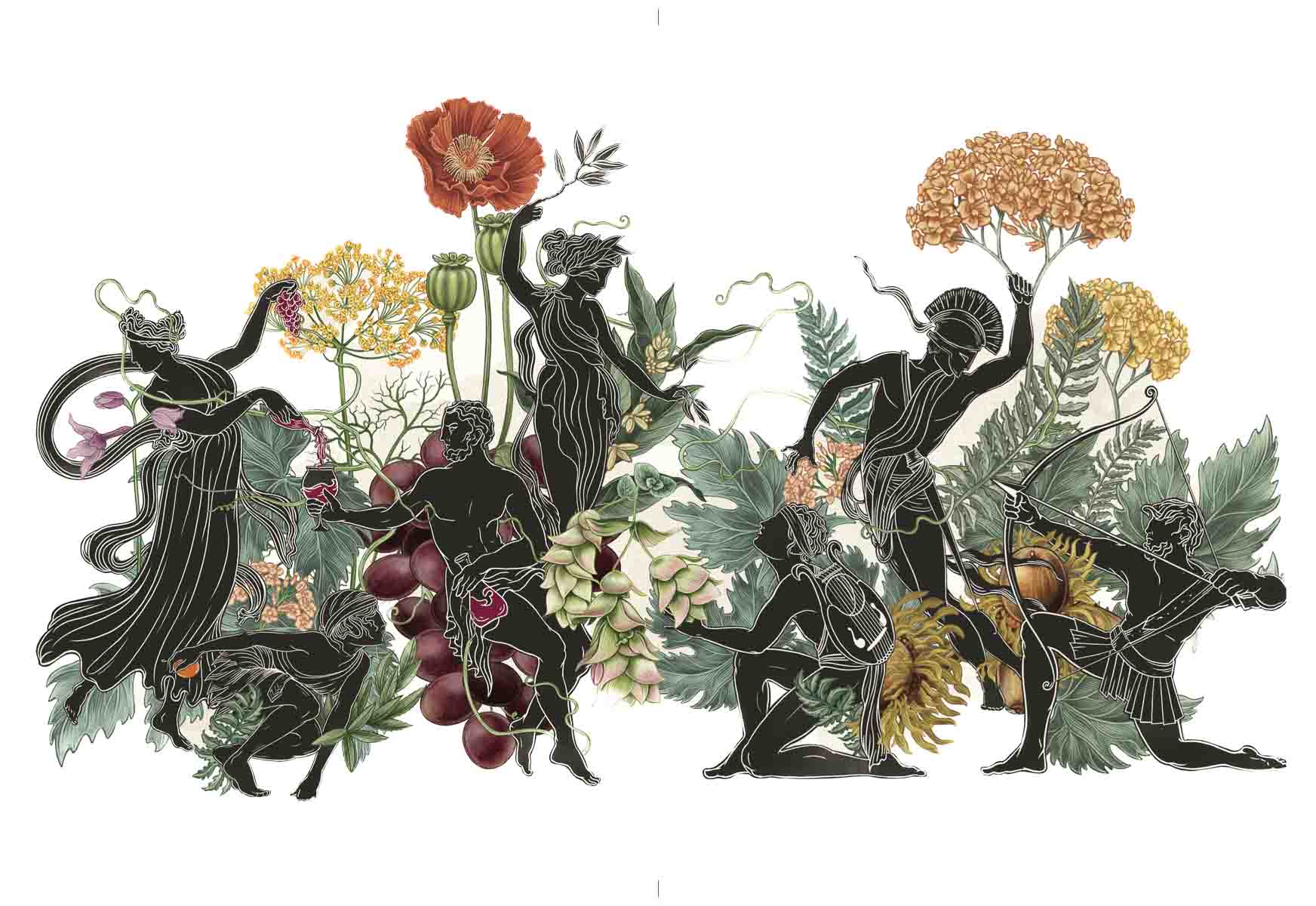

In contemporary times, the term “herb” typically evokes images of aromatic seasonings for culinary dishes or remedies derived from nature. However, in the world of ancient Greece, herbs transcended these roles, embodying extraordinary narratives of creation, mystical attributes, and reverence from both humans and divine beings alike.
Mugwort (Artemisia vulgaris)
The herb known as mugwort derives its name from Artemis, the twin sibling of Apollo, who reigned over domains such as light, music, and healing arts. It was commonplace in mythology for deities to oversee a variety of duties. Artemis gained fame primarily as the chaste deity of the wilderness hunt, yet she also safeguarded females during the delicate phases of pregnancy and delivery. Certain historians posit that the festivals dedicated to Artemisia may have originated as vibrant spring rituals centered on fertility, coinciding with the full moon’s glow. During these events, attendees would consume mugwort, symbolically partaking of the goddess herself (Albert-Puleo, 1978; Rätsch, 2005).

The ancient Hellenes employed mugwort in diverse applications for addressing women’s reproductive health concerns. When the leaves were burned and inhaled, they acted as a soothing agent to alleviate labor pains during childbirth. Modern scientific investigations further validate these uses, demonstrating that extracts from mugwort foliage possess the ability to normalize menstrual rhythms and exhibit potent anti-implantation properties, thereby affirming its historical efficacy as a contraceptive method (Ekiert et al., 2020).
Artemis showed no mercy to those who violated her sacred principles of purity and restraint. For instance, the hunter Actaeon unwittingly came upon her while she bathed, prompting her to transform him into a stag, after which his loyal hounds savagely devoured him (Callimachus). In stark contrast, when women endured the agonies of giving birth, Artemis extended compassion through her eponymous plant, providing relief in their time of need.
Parsley (Petroselinum crispum) & Celery (Apium graveolens)
In the Peloponnesian locale of Nemea, the royal household joyously marked the arrival of their infant son, Opheltes, by consulting the prophetic oracle at Delphi for insights into his future. The seer proclaimed that the child would enjoy a prolonged and prosperous existence, provided he remained untouched by the earth until he mastered walking. This condition appeared straightforward enough on the surface.

Evidently, Hypsipyle, the nurse entrusted with Opheltes’s care, overlooked this crucial directive. One fateful afternoon, while tending to the young prince, she paused to converse with a band of traveling warriors. She shared her poignant story of single parenthood and enslavement, and in the midst of their discussion, Hypsipyle momentarily placed Opheltes upon a lush patch of celery foliage.
Unseen by all, a venomous serpent lurked nearby and struck the infant, leading to his untimely demise. From the spilled blood of Opheltes sprang the herb parsley. To honor the fallen child, elaborate funeral competitions were organized, evolving into the prestigious Nemean Games (Apollodorus). These athletic spectacles, akin to the Olympic gatherings, attracted athletes from across the Greek territories, with victors adorned in crowns woven from celery leaves.
Rue (Ruta graveolens)
The ancient Greek realm extended far beyond the boundaries of present-day Greece, encompassing regions of North Africa, territories bordering the Black Sea, and areas in the Middle East. In Pontus, situated in what is now Turkey, King Mithridates held sway as a formidable and unrelenting conqueror. Despite his martial prowess, he harbored a profound dread of assassination by poison. To counter this peril, the king formulated what he deemed an all-encompassing antidote. This formula came to light following his demise, with rue standing out as the key herbal component (Pliny the Elder).

Equally captivating, though improbable, is the tale of how Medea wielded rue to deter her spouse Jason from romantic entanglements. Having aided Jason in acquiring the fabled Golden Fleece, the pair embarked on their return voyage to Greece. Along the way, their ship skirted the shores of Lemnos island. Medea, aware of Jason’s prior liaison with the island’s princess during his earlier journey, burned with jealousy despite it predating their union. In a cunning act, she cast rue into the surrounding waters. Legend recounts that the women of Lemnos, upon bathing in these rue-laced waves, emitted an odor so repugnant that no suitors dared approach (Detienne, 1994).
While such a scenario strains credulity, rue indeed played a part in ancient Greek contraceptive practices. The plant inhibits embryonic implantation and served as a recognized abortifacient. Contemporary research reveals its potential to induce infertility in certain male mammals (Abebe, 2021). Medea’s intuition regarding its properties may have held more truth than fiction.
Tansy (Tanacetum vulgare)
Ganymede, offspring of Tros—the esteemed founder of Troy—was renowned as the epitome of mortal beauty (as chronicled by Homer). Zeus himself became enamored with the youth. On a pivotal day, Zeus either dispatched an eagle to abduct the boy or shapeshifted into the majestic bird for the deed. Transported to the celestial heights of Mount Olympus, Ganymede assumed the role of Zeus’s cupbearer and possibly fulfilled additional intimate duties.

As recompense, Zeus bestowed upon Ganymede’s father a duo of divine horses identical to those ridden by the gods. For Ganymede personally, Zeus offered a potion crafted from tansy, granting the boy eternal immortality. Although tansy has a storied legacy in herbal medicine, certain preparations are now viewed as hazardous. Its essential oils harbor thujone, a compound toxic to humans when consumed in excess (Georgescu et al., 2014). Nevertheless, aqueous infusions have been safely utilized by practitioners for countless generations. One ponders the precise nature of Ganymede’s draught: Did it necessitate his mortal death as a prerequisite for transcendence? Ganymede endures eternally in the night sky as the constellation Aquarius, forever the water-bearer (Hyginus).
Numerous remedies from ancient Greece may strike modern audiences as outlandish, yet without access to contemporary labs or sophisticated tools, the Greeks crafted potent herbal solutions that continue to inform herbal traditions today. Deeper explorations into flora pivotal to Greek legends await in explorations of mythic botanicals from divine realms.