

Curiously, during the month of November—before any hint of holiday cheer had truly descended—I discovered myself captivated by a charming tree skirt adorned with tiny mushrooms. No festive bells were ringing yet. This discovery brought a smile to my face, as it reminded me of my days managing a gift shop, where we strictly adhered to an unbreakable rule: the Christmas season officially commenced only on the day following Thanksgiving. That boundary was non-negotiable, defended with vigilance.
However, contemporary life has grown more flexible, and evidently, so have my own perspectives. Nowadays, seasons blend seamlessly into one another, and occasionally, a touch of festive enchantment arrives ahead of schedule, gently nudging your awareness. Thus, in that November moment, I embarked on what became an unexpected winter narrative. Perhaps it reflects the spirit of our era, or maybe it’s a personal shift. Alternatively, it could simply be the influence of those intriguing mushrooms.
Typically, around the winter solstice, my writings center on culinary delights, time-honored customs, and the seasonal herbs—think bubbling pots of spiced concoctions, aromatic herbal infusions, and all those verdant elements that ease the extended evenings of darkness. Yet, the essence of the season possesses an uncanny ability to astonish, redirecting our focus to unforeseen subjects. This time around, rather than delving into rosemary sprigs or bay leaves, my curiosity led me to pursue the legend of a mischievous mushroom. It serves as a poignant reminder that nature’s flora ultimately charts the course, occasionally veering into the more eccentric realms of traditional tales.

Then, as though the cosmos itself sought to emphasize this revelation, I unpacked a container of holiday adornments, and there they appeared—enchanting miniature red-and-white toadstools nestled within the wreaths, concealed among vintage baubles, and cozied up beside my antique Father Christmas figures, patiently biding their time.
And so, the tale unfolds…
Raised as a free-spirited child of the 1970s, specific notions instantly pique my interest, evoking memories of an era when we believed enchantment lurked behind every leafy frond. Terms like psychedelic fungi, airborne reindeer, and ancient pagan solstice ceremonies—these are the intriguing elements that surface unexpectedly while one is merely appreciating an endearing mushroom-embellished Christmas tree skirt on social media.
That precise scenario sparked this entire journey. While casually browsing this delightful tree skirt, a commenter on Facebook dropped a provocative idea into the discussion: ‘Those mushrooms play a significant role in pagan lore that inspired the flying reindeer of Christmas folklore. The deer consume Amanita mushrooms, granting them the power of flight.’
That comment ignited everything. My inner herbal enthusiast immediately geared up for an exploratory quest. Mention ‘folklore-connected mushroom’ anywhere near me, and I’m already en route to the woods, equipped with a flask of hot beverage, a journal for notes, and perhaps a dash too much enthusiasm.

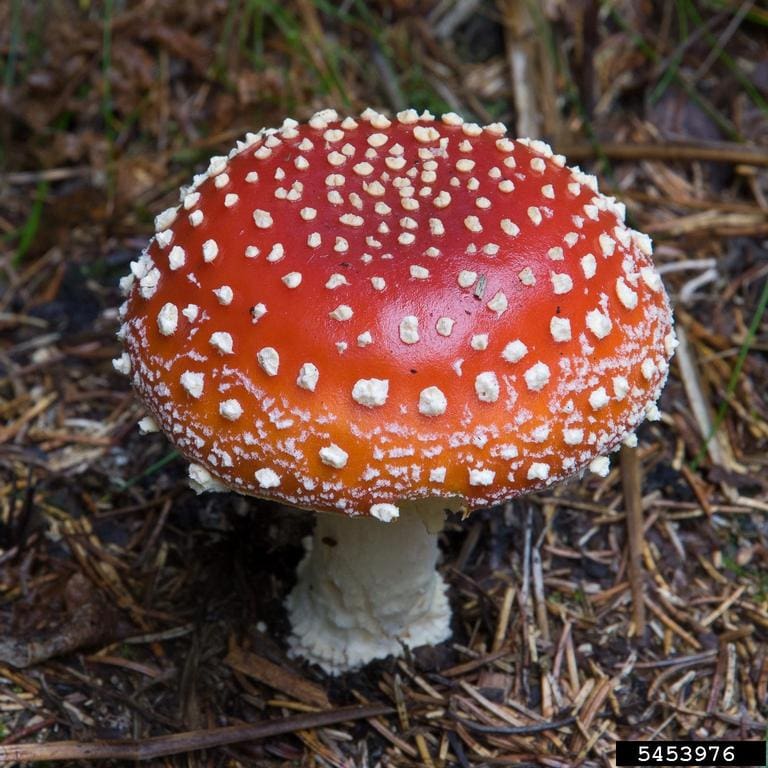
Amanita muscaria, the iconic red-capped, white-spotted mushroom that children instinctively sketch when prompted to illustrate a fungus, takes center stage in this tapestry of folklore. From a botanical standpoint, it thrives in symbiosis with coniferous trees such as spruce, pine, and fir. These are not mere coincidental companions; they form a profound mycorrhizal relationship, where the fungus intertwines with the tree roots, exchanging essential nutrients in a mutually beneficial underground network akin to a shared larder. This partnership benefits the trees, enriches the soil, and sustains the broader ecosystem of the woodland. Consequently, those vivid crimson caps emerge like natural decorations beneath the very evergreens we harvest to bring indoors each December.
Indeed, to address the common query upfront, Amanita muscaria is notably toxic to people. It doesn’t belong to the benign, euphoric varieties romanticized in past counterculture narratives. Instead, it promises an intensely prolonged and uncomfortable experience. Much like herbalists revere belladonna in a historic garden for its allure, we regard Amanita with a mix of admiration and caution—visually striking, steeped in legend, yet something to observe from a safe distance without any direct contact.
Amanita muscaria transcends mere ornamentation. Its presence signals a thriving woodland environment, where the soil teems with vital microbial activity. It acts as a vibrant red-and-white indicator that the forest ecosystem is functioning optimally. Similar to numerous plants embedded in rich folklore traditions, it straddles the line between everyday utility and mythical significance. Consider hawthorn safeguarding portals, elder demanding reverence, rosemary preserving recollections—and then Amanita, which proclaims its tales more boldly, its narratives emblazoned vividly on its distinctive cap.

In northern regions, reindeer actively forage for these mushrooms as a treat. They devour them, resulting in behaviors that could poetically be described as flight—though more accurately, they exhibit exuberant leaps, unsteady gaits, vigorous bounds, and an overall frenzy of wintry exuberance on cloven feet.
Shamans from Siberian and Finno-Ugric traditions incorporated Amanita muscaria into their winter solstice ceremonies. They donned garments in striking red and white hues, suspended the dried fungi from branches like woodland ornaments, and, when blizzards sealed their yurt entrances, accessed the interior via the roof’s smoke vent.
A figure clad in red and white descending into homes through the chimney bearing gifts during the cold season.
Such recurring motifs are the delight of folklore.
This doesn’t imply that Santa Claus was a hallucinogenic shaman—though it would certainly make for a captivating film. Rather, it highlights how the origins of our contemporary winter symbols delve far deeper and more untamed than the polished, commercialized depictions we know today.

Adding to the peculiarity, mushrooms infiltrate holiday motifs beyond this narrative. In the Victorian period, fascination with Amanita muscaria led to their prominent featuring on Christmas cards. These bold red fungi stood alongside holly branches and snowy landscapes as if they were quintessential elements of the festivities.
Putting it all together, we encounter reindeer drawn to these fungi, shamans entering ecstatic states suggestive of flight, attire in signature red and white, chimney-based entries, profound evergreen associations, and a whole Victorian society exchanging mushroom-adorned seasonal cards as a perfectly ordinary custom.
It’s not that Christmas traditions originated solely from mushrooms. Instead, these fungi intricately threaded themselves into the fabric of our collective winter psyche and endured. They echo through folklore, artistic expressions, ceremonial practices, and reemerge annually on whimsical tree skirts and antique correspondence, poised for an inquisitive herbalist (that’s me, tipping my hat!) to weave the connections.
This is precisely why plant lore captivates me so profoundly. It defies confinement, refuses to follow prescribed paths, spreads its roots invisibly, interlaces with diverse elements, and then erupts into prominence at the most surprising junctures. Radiant, unconventional, crowned with a scarlet hat. After tracing this storyline across ancient legends, sylvan groves, and Victorian curiosities, I’m more convinced than ever that enchantment persists behind every frond—merely sporting a red-and-white cap in this instance.

Now, you’ve piqued my interest in turn. How many of you harbor these diminutive red-and-white mushrooms within your own holiday storage? Perhaps slyly integrated into garlands or balanced on a bough, camouflaged so seamlessly that their origins have faded from memory. For some, this revelation might come as no shock whatsoever. Should you uncover them, I’d be thrilled to hear about it and see photos. Sharing glimpses of the mushroom enchantment lurking in your festive treasures would be wonderful.
May your season brim with cozy warmth and awe-inspiring moments, evergreens gracing your thresholds, beneficial herbs filling your cooking spaces, and unexpected bursts of magic emerging right where they’re least anticipated.
Warmest holiday greetings to you and your loved ones.
Beth